

Hi! I‘m a 2nd year PhD student in Psychology at Johns Hopkins University, advised by Dr. Shari Liu at the Look, Infer, and Understand Lab. Interested in social cognition, I use behavioral and fMRI approaches to explore how people's understanding of other agents’ actions interact with their physical and biological reasoning in both children and adults. Before grad school, I have also worked with Dr. Jill de Villiers and Dr. Brianna McMillan on Theory of Mind and language when I was an undergraduate at Smith College.
Outside of research, I enjoy live music 🎶, playing electric guitar 🎸, and open-world games 🎮.
Warning
Problem: The current name of your GitHub Pages repository ("Solution: Please consider renaming the repository to "
http://".
However, if the current repository name is intended, you can ignore this message by removing "{% include widgets/debug_repo_name.html %}" in index.html.
Action required
Problem: The current root path of this site is "baseurl ("_config.yml.
Solution: Please set the
baseurl in _config.yml to "Education
-
 Johns Hopkins UniversityDept of Psychological & Brain Sciences
Ph.D. StudentSep. 2024 - present -
 Smith CollegeB.A. in Psychology and Data ScienceSep. 2020 - May 2024
Honors & Awards
-
CogSci 2026 Student Travel Award2026
-
Magna Cum Laude, Smith College2024
Publications (view all )
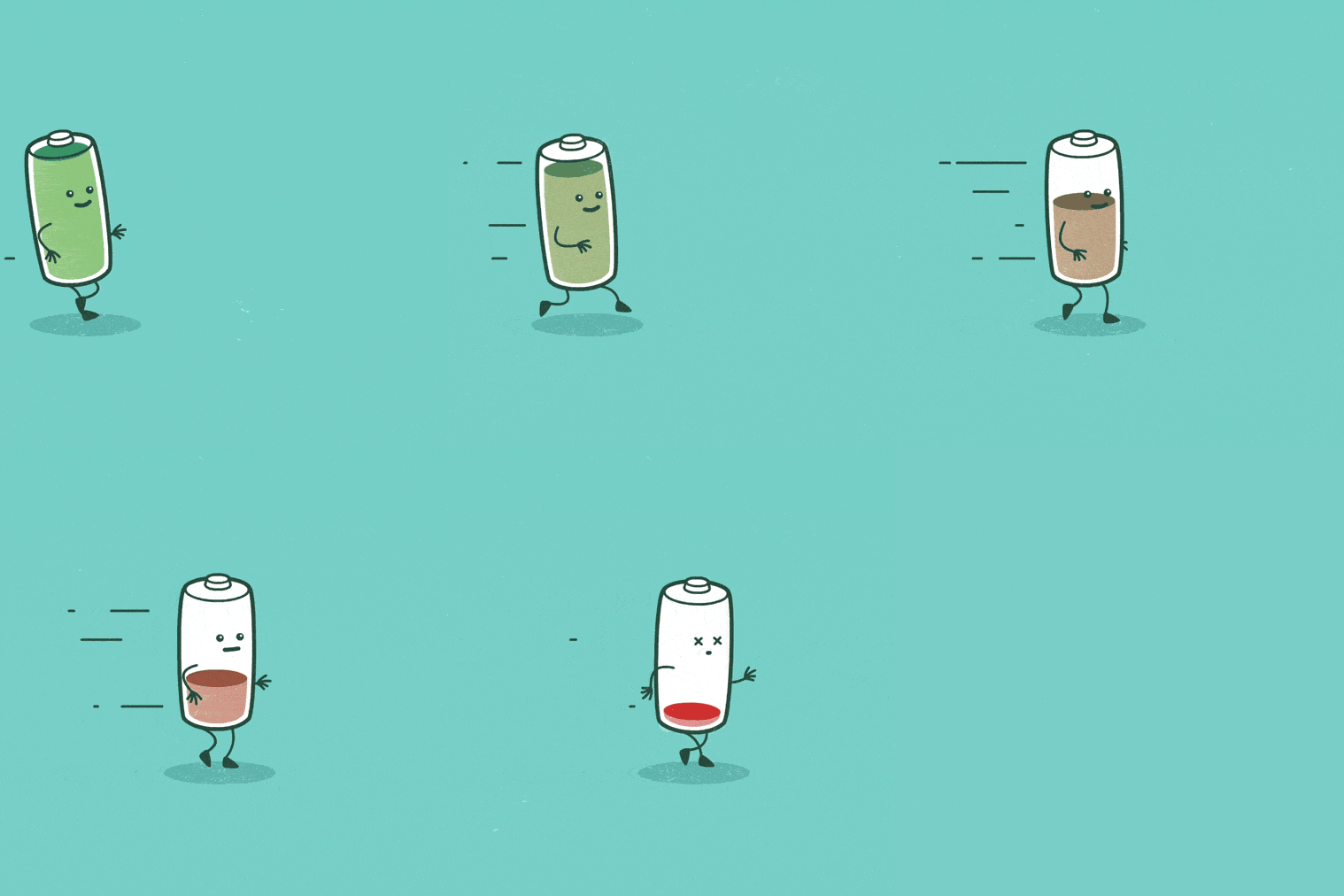
How an understanding of bodily energy constrains theory of mind
Keyu Amber Liu, Shari Liu
Proceedings of the Annual Meeting of the Cognitive Science Society 2026 Talk
Theory of mind allows us to connect other people’s behaviors with their hidden mental states (beliefs, desires, emotions). Yet, in addition to mental beings, people are also living organisms with physiological states (e.g., feeling tired or energetic). How do we incorporate these physiological states in our reasoning about other agents? Across three pre-registered experiments (total N = 232), we test the hypothesis that US adults use a concept of bodily energy - a resource of the living body that fuels action - to reason about the minds and behaviors of other agents. Adults systematically judged that certain actions would cause an agent’s energy to rise vs. fall, used an agent’s energy state to reason about action cost, and used an agent’s beliefs about action cost to infer their energy state. These results are consistent with the proposal that our theory of mind connects other agents’ actions with their mental and physiological states.
How an understanding of bodily energy constrains theory of mind
Keyu Amber Liu, Shari Liu
Proceedings of the Annual Meeting of the Cognitive Science Society 2026 Talk
Theory of mind allows us to connect other people’s behaviors with their hidden mental states (beliefs, desires, emotions). Yet, in addition to mental beings, people are also living organisms with physiological states (e.g., feeling tired or energetic). How do we incorporate these physiological states in our reasoning about other agents? Across three pre-registered experiments (total N = 232), we test the hypothesis that US adults use a concept of bodily energy - a resource of the living body that fuels action - to reason about the minds and behaviors of other agents. Adults systematically judged that certain actions would cause an agent’s energy to rise vs. fall, used an agent’s energy state to reason about action cost, and used an agent’s beliefs about action cost to infer their energy state. These results are consistent with the proposal that our theory of mind connects other agents’ actions with their mental and physiological states.